Share First Christian Church's obituary with others.
Invite friends and family to read the obituary and add memories.
Stay updated
We'll notify you when service details or new memories are added.
You're now following this obituary
We'll email you when there are updates.
Select your format and elements to print


First Christian Church
b. Aug 6, 1892
Corbin, KY
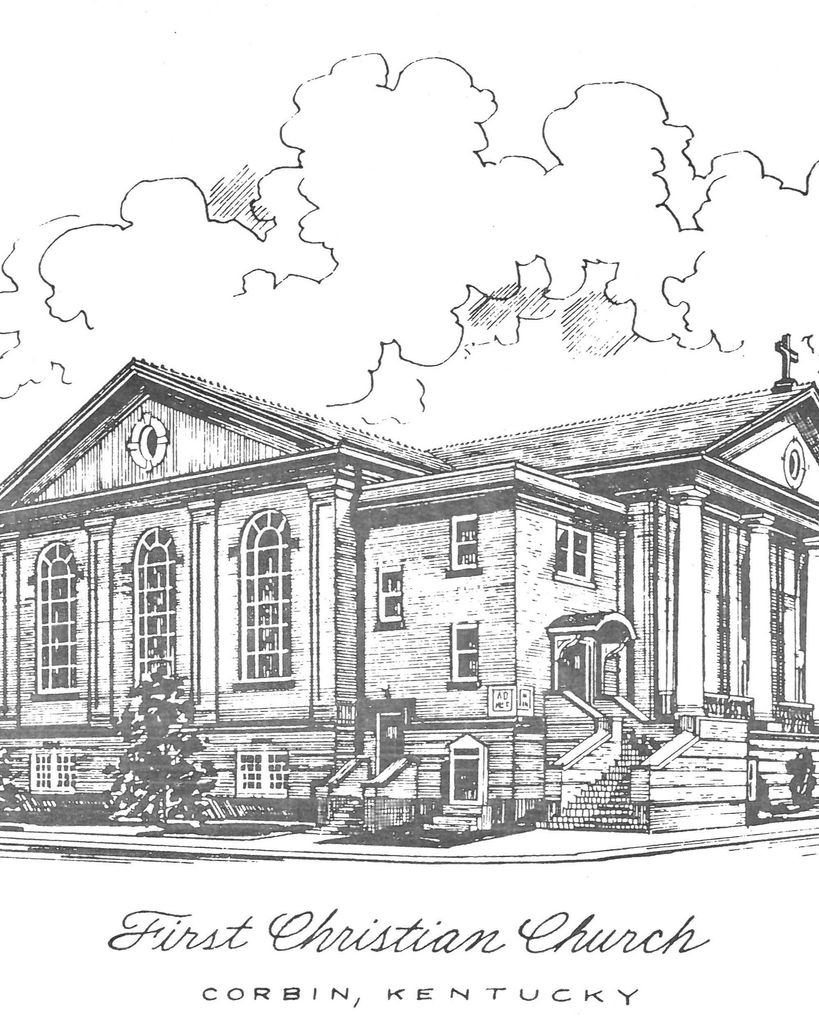
The First Christian Church of Corbin, as a body of believers, is thirty-three years older than the building we celebrate today. The church was organized by evangelist John Wesley Masters, who planted quite a few churches across Kentucky. This took place in 1892, the same year that L&N expanded its railroad hub in Corbin. Corbin itself was incorporated as a town three years later. At that first organizational meeting, held on August 6, 1892, twenty-seven founding members were present. Masters was named as the first FCC pastor and also as an elder. Other elders named were W. P. Durham and D. T. Chesnut. Deacons assigned were J. W. Martin, L. M. Belew, and W. B. Sutton, while Mr. Durham was also named clerk.
Then called the First Church of Christ, the congregation met at the chapel of the old Christian College, on what is named College Street for that very reason. The site is now St. John’s Episcopal Church park. In 1899, a janitor was oiling the floors of the building when his lantern fell and ignited the fresh oil. The building burned completely, and the college folded.
The FCC congregation then met in various community buildings until a donated lot on Ford Street allowed them to build a church. However, the congregation faced constant problems in that location. The cheaply made brick crumbled, so a frame church was built instead. That building was struck by lightning twice and eventually burned down. The congregation swapped the lot for a new location at the corner of Center Street and Christian Street in East Corbin, and the first brick church in Corbin was completed in 1908. During this time, FCC had the largest congregation in town. In 1909, the church voted to secure a $1,500 loan from the Christian Missionary Society to cover outstanding construction costs. That site is now home to First Pentecostal Church.
Meanwhile, the FCC congregation kept growing and soon needed a larger church. Pastors during this period included John W. Masters, T. E. Utterback, F. C. Button, Paph Julian, Robert Boatman, Jim Cole, T. M. Myers, R. E. L. Abbott, W. Henry Warren, and J. B. Darnold.
In 1920, the FCC congregation secured a lot on Kentucky Street for a much larger church. The building committee consisted of H. E. Everman, Mrs. J. A. Gilliam, James T. Nelson, and S. L. Wilburn. They were joined by pastor A. W. Rethemeyer when he began leading the church in 1922. This committee bought the lot and oversaw building plans and construction without any disputes among them on decisions. The congregation made pledges and raised funds for the new building.
From 1921 to 1926, FCC members met in a tabernacle, first on the new church lot and then, beginning in 1923, in donated space on the same block so the foundation could be dug. They still owned the Center Street church, so the move may have been because the congregation was too large for it, because they wanted to rent it out, or perhaps simply as an act of faith that the new church would be built soon. In 1922, the church organ was loaned to the South Corbin Church of Christ, but there is no record of whether it was ever returned. That year, the building fund was too low to begin construction, so pledges were temporarily loaned back to members.
The first architect the church engaged did not work out, which proved to be a blessing. FCC then hired Albert A. Honeywell of Kokomo, Indiana, a Christian Church minister as well as an architect who specialized in designing churches. The cornerstone of the current church building was laid in 1925, and the building was dedicated at a worship service on June 27, 1926. By then, FCC’s membership numbered around nine hundred people.
The church had installed a grand pipe organ from the Henry Pilcher’s Sons Organ Company of Louisville, which still produces beautiful music today. The purchase was made possible by a grant from the Andrew Carnegie Foundation, which covered half the cost. In 2024, FCC began a restoration project to repair, upgrade, and refurbish the organ at a cost of more than $40,000. Major contributors are recognized with the plaque we are unveiling today. We pray this organ will continue to produce beautiful music for another ninety-nine years.
The new sanctuary was equipped with 1,313 folding seats, some of which are still in use in our balcony. The leaded stained glass windows, now appraised at more than $200,000, were protected with plexiglass in the 1960s and with glass overlays in the 1970s.
Making mortgage payments during the Great Depression was a struggle. Some members had even mortgaged their homes to support the building fund. The congregation held ice cream socials and public dinners for twenty-five cents each. Flossie Eubanks, Lucy Bryant, and Mary Thompson could feed up to four hundred people in a day. The ladies of the church sold space on a quilt they made, embroidering names on the squares at ten cents each, or twenty-five cents for a circle. That quilt is now hanging in our choir room.
In 1936, a congregational meeting unanimously approved a resolution to change the name of the church from First Church of Christ to First Christian Church of Corbin. In the years that followed, FCC supported Transylvania College, missionaries abroad, the Kentucky Children’s Home for orphans, the Galilean Children’s Home, the local Girl Scouts, and other Corbin churches whenever they were in need. The building was also made available to organizations ranging from the American Legion to the city schools to the United Service Organizations, or USO. The local health department even held clinics in the basement for years. FCC had been renting out the 1908 Center Street church and eventually sold it to the Church of the Nazarene.
Pastors during this period included I. E. Reid, J. K. Reid, W. B. Carter, A. H. Baugh, R. G. Sherrer, Cleo Purvis, R. G. Sherrer again, A. W. Rethemeyer, Festus N. Wolfe, and Dallas Gladson.
In 1943, more than twenty years after the project had begun, all of the loans for church construction were consolidated through a $29,000 loan from the Disciples Board of Church Extension. Mortgage payments were set at $290 a month. In 1950, member Harland Sanders took to the pulpit to exhort church members to step up and get the church out of debt. There is no record of what effect his speech had, and it was the only time Sanders is mentioned in the church board archives.
In the 1950s and ’60s, the sides of the church balconies were closed off to form much-needed Sunday School classrooms, air conditioning was installed, and part of the fellowship hall in the basement was partitioned to create a youth chapel.
To raise funds for debt relief and outreach programs, the ladies of the church made fried donuts in the church kitchen and sold them every Saturday morning. They also sold bottles of vanilla, and later artisanal brooms, which we still sell today.
In January of 1966, a fire that began in the church basement damaged the lower level, and smoke damage caused the organ pipes to lose their plating, though they remained functional. In 1975, a remodeling project was launched that cost more than twice the original construction cost from fifty years earlier. On September 14, 1975, the dedication of the newly remodeled sanctuary was held in conjunction with the building’s fiftieth anniversary.
FCC had pioneered the election of women as deacons in 1923, but that practice ended in 1926. Still, women continued to play a vital role in church leadership. In 1978, the election of Eugenia Gover made the role of women deacons permanent. In 1983, the junior deacon program was revived to include young women. In 1989, Margaret Thurman and Jeanette Ladenburger were installed as the first women elders. Lee Ann Strunk and Joyce Fox were added in 1991, making them the longest-serving active elders today, with thirty-four years of service.
Pastors during this period included Elmore Turner, John S. Chambers, C. N. Barnette, John S. Chambers again, William Huie, Elmore Ryle, and C. H. Dudley, who had the longest tenure of any pastor, serving FCC for twenty-eight years.
During the 1970s, ’80s, and ’90s, FCC greatly expanded its programs for both youth and adults. These included the drama club, art classes, and Wednesday night meals before Bible study. Traditions were started, such as the annual Valentine’s Day dinner that featured the election of Valentine Royalty, and the annual Christmas Craft Bazaar and Luncheon, which is still held every year on the first Saturday in December.
Pastor Dudley and his wife, Juanita, sponsored a group trip to the Holy Land in 1980, visiting Athens as well as Israel. The youth of the church raised money for a second trip in 1984, when they traveled to Rome, Israel, and Egypt.
In 1980, the church presented The Living Lord’s Supper, a dramatic recreation of the Last Supper for Maundy Thursday, produced and directed by Juanita Dudley. The presentation was a resounding success and continued for several years. Costumes were rented the first year, but when the community requested an encore, the ladies of the church sewed costumes and bought wigs for future productions. The performance was revived in 2019 under the supervision of Juanita Dudley, with Jerry Blankenship as the only cast member to reprise his original role. Pastor Tibbs’ beard remains a lasting legacy of that performance. Subsequent productions were halted by the COVID-19 pandemic, but we hope to present it again.
In 1986, the church building was added to the National Register of Historic Places.
In 1987, the FCC bell choir was formed. Lee Ann Strunk, the only remaining member of that inaugural group, now leads the choir.
In 1992, a grand celebration was held to mark the congregation’s 100th anniversary.
In 1997, FCC became the first church in southeastern Kentucky to participate in Operation Christmas Child, overseen by Joyce Fox. For the next twenty years, FCC served as the hub for Christmas boxes packed by other churches.
In 2005, Sam and Ed Tye presented the board with the idea of feeding hungry schoolchildren on weekends. Doris Moore was appointed to head the program. A school principal had told Doris that children lined up on Monday mornings eager to get into school because they had not eaten all weekend. The congregation responded by packing thirty food bags that first week. Doris sought help from other churches, which eagerly joined in. That was the beginning of the Corbin Community Backpack Program, which has since expanded to involve many local churches, businesses, and civic organizations. Still overseen by Doris Moore and headquartered in the house next door, the program now packs around a thousand bags of food for Whitley and Knox County students every weekend.
First Christian Church also proudly recognizes those who grew up here and went on to ministry. In the early 1960s, Randall Odell Martin answered the call to missionary work in Africa. FCC supported him financially, even purchasing a Jeep intended to be shipped overseas through the Disciples of Christ diocese. The Jeep never arrived, however, and that incident led to the first church split and lasting tension between FCC and the diocese.
Three others also became ministers: Coy Jo Bays, who served in Knoxville, Tennessee; Jeff Bell, who served in Paris, Kentucky; and Randy Wilson, who ran a folk ministry in Redbird, Kentucky, where he also built a pioneer settlement to teach traditional living. All of these ministries are part of FCC’s legacy.
We also remember our church members who served in the military in every war, whose names are displayed on a plaque.
Pastors during this period included C. H. Dudley, Carl Helm, Don Nunnelly, Darrell Vandervort, David Blondell, Cameron Pennybacker, David Blondell again, John Gill, Jerry Combs, Greg Nunley, Robert Stauffer, and Ronnie Mitchell, who continues to serve as associate pastor. Our current pastor, Rev. Dr. Robert Tibbs, and his wife, Debbie, have faithfully led the flock for the past six years, and we are very grateful for them.
Service Schedule
Past Services
A Walk Through History - Homecoming 2025
Sunday, September 28, 2025
10:30 - 11:30 am (Eastern time)
First Christian Church
A special time of food and fellowship to follow.
Guestbook
Visits: 47
This site is protected by reCAPTCHA and the
Google Privacy Policy and Terms of Service apply.
Service map data © OpenStreetMap contributors